That double reading is the point. A figure juggling boxes can be multitasking, logistics or a busy week. A person sitting cross-legged with fire on their head can be burnout, focus or a bright idea. You pick the meaning with your copy, and the art goes along with it.
The style: dry ink, one colour, odd logic
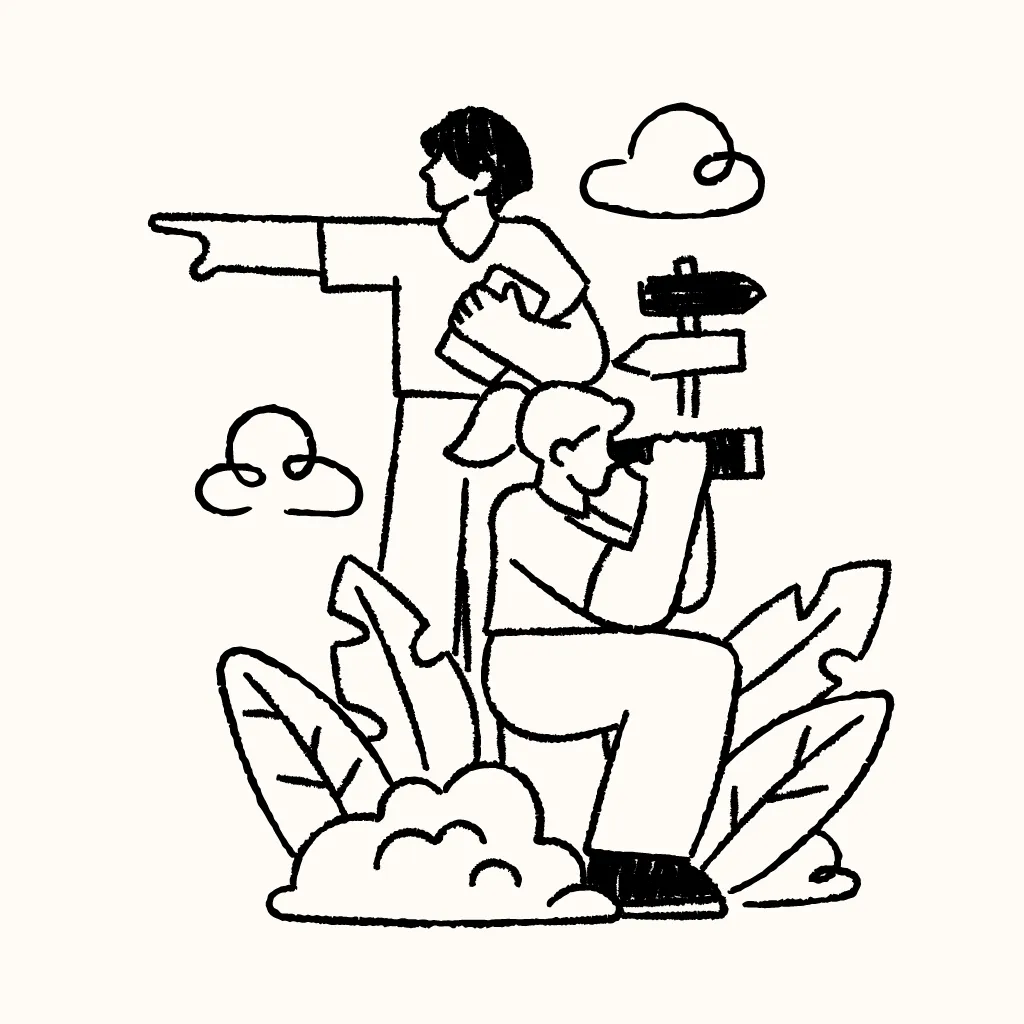
The line looks like a soft brush pen or wax crayon dragged across rough paper. It's thick, close to one weight, with a grainy broken edge instead of a clean vector stroke, and corners wobble the way a real hand wobbles. Black does nearly all of the work. Boots, shoes and the odd trouser leg are filled solid black, which gives each figure a heavy base and keeps it from floating.
The second colour is a warm coral red, about #F85B4E. It shows up as a textured fill on a flame, a tie, a price tag or a hat, and sometimes as a coral line for ripples, wifi signals, smoke clouds and motion arcs. There are no gradients, no shadows and no backgrounds. Each illustration sits alone on a square artboard with a few props, a bush or a cloud at most.
The characters are where the surreal part lives. Heads get swapped for a cardboard box, a sprouting seed, a long snout or a single eye. Hands are mitts with stubby fingers, limbs are soft tubes, and faces are mostly two dots or nothing at all. It's deadpan and a little strange, not cute and not corporate, which is why it stands out on a page full of smiling stock characters.
What is inside the 100 illustrations
Chapter 5 is a mix of single characters, creatures and object scenes. The subjects lean toward everyday product and marketing topics, drawn sideways:
Work and productivity: laptops on clouds, juggling, writing, deadlines and desk life
Communication and digital life: speech bubbles, phones, wifi, email birds and paper planes
Health and care: pills, syringes, an IV drip and meditation poses
Money and shopping: coins, gems, flying cash, price tags and gift boxes
Life, weather and space: birthdays, strollers, gardening, rain, lightning, rockets and UFOs
Who it is for
Product designers get the most out of it. A 404 page, an empty inbox or a failed payment screen are moments where a slightly absurd image helps, because it admits something went wrong without looking alarmed. The trash can creature and the umbrella in the rain were practically drawn for those screens.
Editorial teams and newsletter writers can use the double meanings for headers on abstract topics like burnout, privacy, growth or remote work, where a literal photo would feel flat. Brand and social teams will like that one coral accent is easy to swap for their own colour, so a full campaign stays on palette.
It also suits agencies pitching a client who wants personality without childish cartoons, and founders building a landing page for a creative tool, a wellness app or a fintech product that wants to sound less like a bank.
How to use it
In Figma, drop the SVG onto the canvas and every shape stays editable. Select the coral fill and change it to your brand colour in one step, or install the GetIllustrations Figma plugin to search and place illustrations without leaving your file. For quick recolouring outside Figma, the SVG colour editor changes the accent in your browser before you download.
In React, Next.js or Webflow, use the SVG inline or as an image tag. The files stay sharp at any size, from a small empty state to a full-width hero. Illustrator users get AI files with the shapes ready to rearrange, which helps when you want to pull a single prop like a cloud or a gift box out of a scene.
A tip: keep the black and change only the coral. The line is what makes the set recognisable, and the accent is what makes it yours.
Formats and technical details
All 100 illustrations come in three formats:
SVG, editable and scalable, for web and Figma
PNG with a transparent background, for slides, docs and email
AI, for Adobe Illustrator
Licence
The commercial licence covers personal and client projects, websites, apps, presentations, marketing, social, print, video and educational material. You can change colours, resize and customise the art. You can't resell or redistribute the files on their own, put them in templates or themes for resale, use them in AI training datasets, or sell merchandise where the illustration is the main value. Credit is welcome but not required.
Pairs well with
Chapter 5 was drawn to sit next to the rest of the series, so you can mix pieces from different chapters on one site. The first Surreality illustrations pack set up the ink and coral look, and Surreality Chapter 2 pushes it toward abstract shapes. Chapter 3 is the outline take with a lighthouse character on the cover, and Chapter 4 is the closest match to this chapter if you need more scenes in the same weight. If you plan to use several chapters, the Surreality illustrations collection bundles the series for less than buying each pack.


 Part of Collection

















 Download
 This file is vector, you can edit the preset colors and scale it to fit any design size using the SVG format